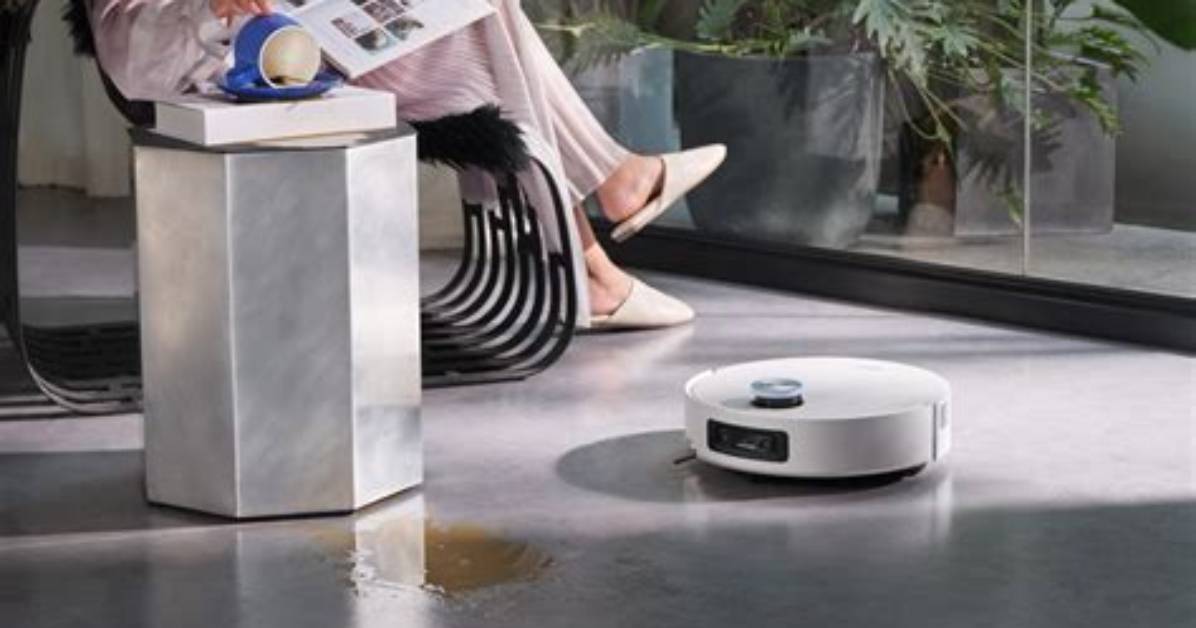
In the modern world of smart devices, you can automate nearly any part of your day. Robot vacuums can clean the floor. Smart dishwashers can turn on when you leave so you have clean dishes when you come home. Now, even mopping can be taken care of by automatic devices.
No one really enjoys mopping. It’s a time-consuming chore, and even though products have come along over the years to speed up the process, no floor is ever cleaned as much as it should be. Robot moppers help by doing the task every day and significantly reduce the amount of dirt and grime on hardwood and tile floors — but are they really clean?
Most robot moppers can’t sanitize floors. Cleaning built-up dirt and debris has little impact on the number of bacteria and viruses that live on the surface if the proper cleaner is not used. You can’t put a disinfectant cleaner into a robot mop, though. Here’s why.
The kinds of robot moppers
There are two basic kinds of robot mops.
There are single-purpose devices, including the iRobot Braava line, which only mop floors (though many single-purpose robot mops can do a dry sweep before spraying the floor with a cleaning solution). This dry sweep helps to clean dirt and debris from the floor and clear anything that might interfere with the mopping.
There are also 2-in-1 options, such as the Roborock S6 MaxV, a device that both vacuums and mops the floor. Most 2-in-1 devices do not make the distinction between jobs independently; the user has to swap out the vacuuming pad for a wet pad on the bottom of the robot mop. There are some exceptions to this, however. Some models of robot mops, like the iLife V8, has a chamber that can handle both wet and dry contents.
Due to their dual-duty, 2-in-1 vacuum-mops are typically more expensive, but their mopping performance often do not perform as well as a dedicated device.
How robot mops clean
Almost every robot mop in existence can clean your floor with nothing but plain water, although many do have additional solutions you can add to enhance the cleaning experience. Water is the universal solvent.
Robot mops transport fluid from an internal reservoir through a series of tubes to a nozzle that sprays the floor ahead of the mop. Plain, clean water doesn’t leave behind residue or debris that can clog or inhibit the flow. Combined with a semi-abrasive pad, simple water is enough to clean most spills and stains from the floor.
However, it doesn’t have any disinfectant properties. Killing bacteria and viruses on the floor of your kitchen or bathroom requires different, often harsher chemicals than what are used in a robot mop.
You shouldn’t add anything extra to your robot mop either. If your robot mop includes a cleaning solution, you can mix it with water inside the tank per the directions provided with your device. Straying from these directions can damage the internal components of your robot mop.
The plastic tubes that carry fluid from the reservoir to the nozzle can erode over time due to exposure to strong chemicals. Many chemicals can leave behind particles that build up and form clogs, or find their way into the motor of the device.
Of course, many people make their own cleaning solutions and use it in their robot mops, often for long periods of time before trouble arises. However, doing so voids the warranty.

