- Clear, refined sound with any music
- Wide soundstage in any room
- Versatility of placement
- Tons of connectivity options
- aptX HD Bluetooth
- A bit big for desktops
- Better with a subwoofer
“Hey, do you want to review a set of powered desktop Bluetooth speakers?” is what my colleague asked me. First, of course I do, because I like speakers and I like my job. But one of the most fun parts of reviewing products is when you dig into something new and find that it isn’t what you were expecting.
Sure, the Q Acoustics M20 HD are, at first glance, a pair of powered Bluetooth speakers that I’m sure would be quite content (can speakers be content?) relegated to any home office desktop. And they were, happily tucked in behind my computer monitor for weeks. I was happy, too. Domestic audio bliss. But then I noticed the “Powered Wireless Music System” moniker on the box. Duh.
After removing my palm from my face, I relocated the M20s to a bookshelf in my dining room. Then I tried them with my turntable. Then my TV. And my phone. They’re so moveable I even took them to my cottage. With a ton of connectivity options, from RCA to USB to 3.5.mm AUX to optical to Bluetooth, there wasn’t anything I couldn’t try the M20s with, save for Wi-Fi. You can even hook a subwoofer up to them (more on that later).
Should the Q Acoustics M20 HDs stick to the desktop Bluetooth speaker lane, or are they a muscle car longing for the open road? Should I stop with the car metaphors? And, more importantly, should you buy these speakers? Buckle up.
What’s in the box?
What’s in the box of the Q Acoustics M20 speakers is as straightforward as the speaker system itself. There’s one powered main speaker, and a companion passive speaker. A small box inside the packaging reveals everything else needed to get up and running quickly: a 4-meter (13-foot) speaker cable for linking the speakers, a 2-meter (6.5-foot) power cable, a remote control with batteries an optical cable, two foam bungs for the rear port, and a user manual.
Design and features
Build and drivers
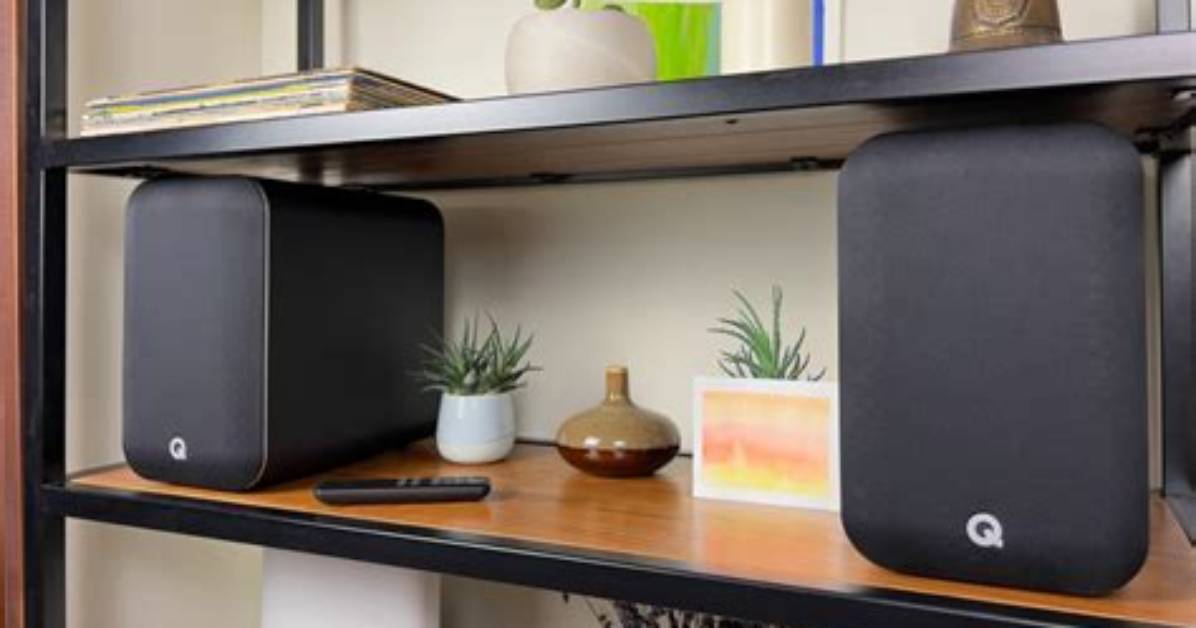
To be clear, the Q Acoustics M20 speakers are not what I would call a small pair of desktop speakers like the more compact, budget set of Monoprice desktops we recently reviewed — these things are substantial, but still moveable. Each speaker weighs a little over 10 pounds (11.25 pounds for the passive speaker and 12.2 pounds for the powered), and they’re solid as a rock with a stylish matte black finish (they’re also available in white and walnut). The mesh grilles are also nice, and are sealed flush to the cabinets with a sleek band of aluminum. This also means that the grilles, unfortunately, do not come off, which might not be a problem unless you need to clean them.
Behind the grilles, each of the M20’s speakers houses a 22mm (0.87-inch) “high frequency” tweeter that is decoupled from the cabinet, which Q Acoustics says helps minimize any unwanted vibrations inside. The midbass driver is a 125mm (4.92-inch) cone that puts out an impressive amount of sound for its size — enough to fill any medium-sized room — and is driven by a built-in 130-watt amplifier. There’s also a rear-firing reflex port on the back to help with bass dispersion, which can be blocked with the included foam bungs to fine-tune the low end if the backs of your speakers need to be close to or flush against a wall. And you may need to do this because, as I mentioned, these speakers aren’t small, at 11 inches tall by 6.7 inches wide and a shelf-filling 11.6 inches deep.
There’s a plethora of connectivity options to this $600 music system.
The top of the powered speaker is where you’ll find a flush power button that cleverly illuminates a different color based on what connection is being used, and up/down volume buttons. You can use the power button to manually scroll through the inputs or you can use the included remote (a nice touch), which is a compact size with all the inputs clearly marked.
All the connections are well organized on the back of the powered speaker (we’ll get into those below), with the passive speaker clean and clear except for the speaker cable terminals.
Connections
This is where the Q Acoustics M20s get fun. As mentioned in the intro, there’s a plethora of connectivity options to this $600 music system. It’s important to note that the M20s are not Wi-Fi-enabled and cannot stream anything over a network like a Sonos system (there is a way, though — read on).
Bluetooth is the wireless connectivity here, but it’s beyond many cheaper systems on the market in that it supports aptX, aptX Low Latency, SBC, and AAC wireless codecs. It also supports the aptX HD Bluetooth codec, which enables high-resolution wireless audio streaming up to 24-bit/48kHz. That right there is some pretty great sound capability, but if you’re even more of an audiophile, you can connect the M20s to a computer via the USB port or hook up the Toslink optical port to a compatible component to unlock lossless audio quality at 24-bit/192kHz — from high-res native files or through streaming services such as Tidal, Apple Music, and Amazon Music Unlimited. The optical ports can also be used to connect the M20s to a compatible TV to run sound through that way.
A set of RCA inputs opens things up even more, allowing connections to everything from CD and DVD players to turntables — and just about anything with the right cables and adapters. You can even use the RCA line-in to connect to Wi-Fi network streaming devices like the Bluesound Node or the Sonos Port — now you’ve got yourself a decent network streaming setup.
The M20s are superb-sounding speakers, offering amazing tonal balance, a wide soundstage, and impressive volume for their size.
There’s also a port for connecting an external subwoofer should you enjoy big bass, and even if a single 3.5mm cable is all you have, there’s one of those on the back, too — I like to have one connected in case friends want to hook up their phones to the speakers without fussing with Bluetooth.

